
Why Bonus Stamps Work: The Endowed Progress Effect in Loyalty Programs
The psychological principle that explains why giving customers a small head start on a stamp card makes them more likely to complete it, and how you can use it in your loyalty program.

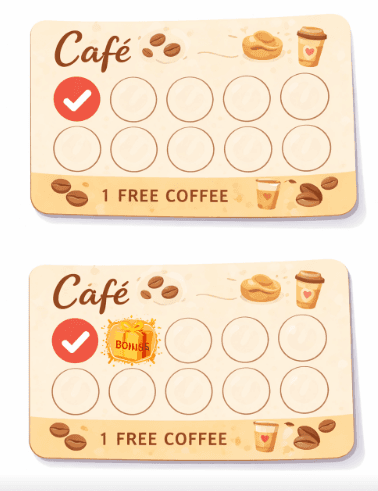
Endowed progress: a head start that drives completion
What Is the Endowed Progress Effect?
The endowed progress effect is a well-documented finding in behavioral psychology and consumer research: people are more likely to complete a goal when they perceive they have already made progress toward it, even when that progress is “endowed” (given) rather than earned. In the context of loyalty and stamp-card programs, this means that giving new members one or two bonus stamps at the start makes the reward feel closer and the remaining effort feel smaller, which increases the chance they will keep engaging and eventually redeem.
As Loyalty & Reward Co summarise: “An individual is more likely to progress towards a goal if they are given artificial advancement towards that goal.” For stamp cards, that “artificial advancement” is the head start you give, and it creates the illusion that less effort is required to earn the reward, which motivates persistence.
The Car Wash Experiment: Evidence From Research
In a classic study, researchers Nunes and Drèze (2006) tested two versions of a car wash loyalty card. One group received a card requiring ten stamps for a free wash, but two stamps were already pre-filled. The other group received a card requiring only eight stamps with no head start. In both cases, customers had to earn eight more stamps, yet the group that started with two “free” stamps had a 34% reward redemption rate, compared with only 19% for the group that started from zero.
When members are given advancement toward a goal, they are more likely to show persistence. Those starting from scratch often see the reward as too far away and disengage.
The takeaway for your business: the same number of visits can lead to meaningfully more redemptions (and more repeat visits) when you endow a little progress up front.
How This Relates to the Endowment Effect
The endowed progress effect is related to the broader endowment effect from behavioral economics: people tend to value something more once they feel they “own” it or have a stake in it. As described on Wikipedia, the endowment effect is “the finding that people are more likely to retain an object they own than acquire that same object when they do not own it,” and it is often linked to loss aversion: the idea that losses weigh more heavily than gains.
When you give customers a few stamps to begin with, you are not only shortening the perceived distance to the reward (endowed progress) but also giving them a small “stake” in the card. They already “have” something, and that makes completing the card feel more worthwhile and dropping it feel like a loss. Together, these psychological forces make head-start stamps a powerful, low-cost way to increase engagement and redemption.
Putting It Into Practice: Welcome Stamps in Your Program
Many successful loyalty programs use this principle in simple ways: join bonuses, welcome points, or, in stamp-card terms, one or two bonus stamps when the card is first added or when the first stamp is approved. The key is to make progress visible (e.g. with a progress bar or filled stamps) so customers see they are “already on their way.”
Offering a head start is especially effective when the reward is clearly communicated and feels attainable. When you combine endowed progress with a clear reward description and a simple path to the next stamp, you align your program with how people actually behave, and that can lead to higher completion rates and stronger loyalty.
Summary
The endowed progress effect shows that a small, symbolic head start, such as one or two bonus stamps when a customer joins or receives their first stamp, can significantly increase the likelihood that they will complete the card and redeem. This effect is supported by research and is consistent with the broader endowment effect and loss aversion. By designing your stamp card to include an optional head start, you are not just being generous; you are using evidence-based psychology to encourage completion and build lasting engagement with your loyalty program.
References & further reading
- Endowment effect, Wikipedia
- Loyalty Psychology Series: Endowed Progress Effect, Loyalty & Reward Co
- Nunes, J. & Drèze, X. (2006). “The Endowed Progress Effect: How Artificial Advancement Increases Effort.” Journal of Consumer Research, Vol. 32, Iss. 4, pp. 504-512.
Use the endowed progress effect in your stamp cards
LOYO lets you add optional welcome stamps (head start) to your digital stamp cards so more customers complete and redeem.